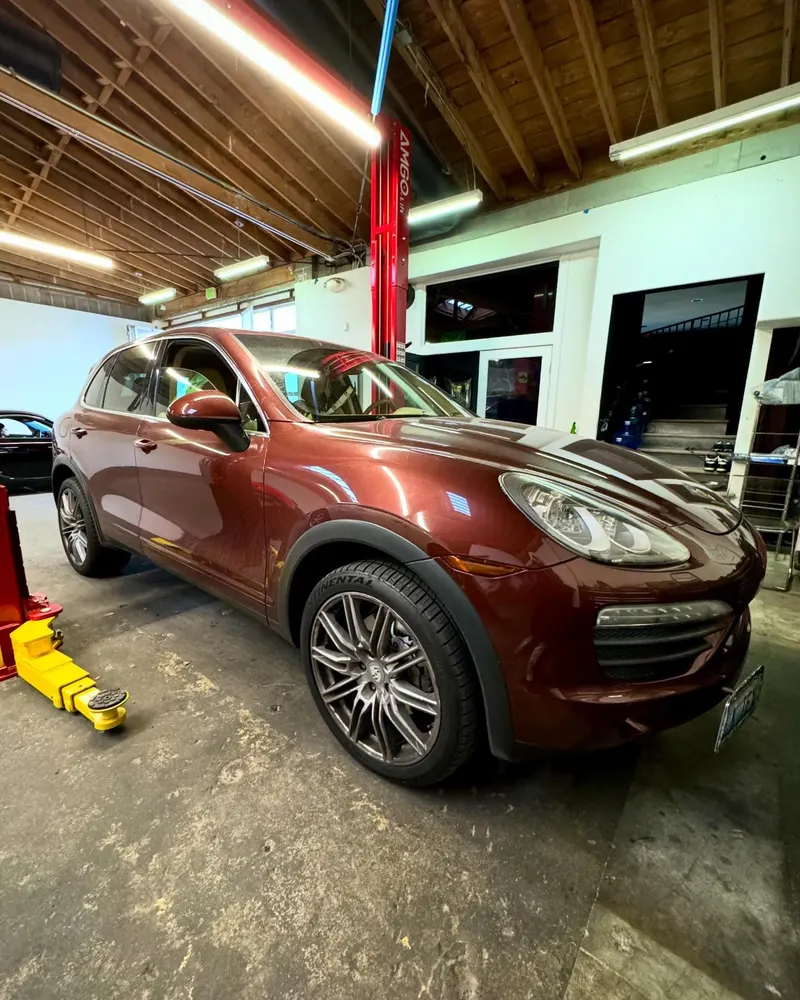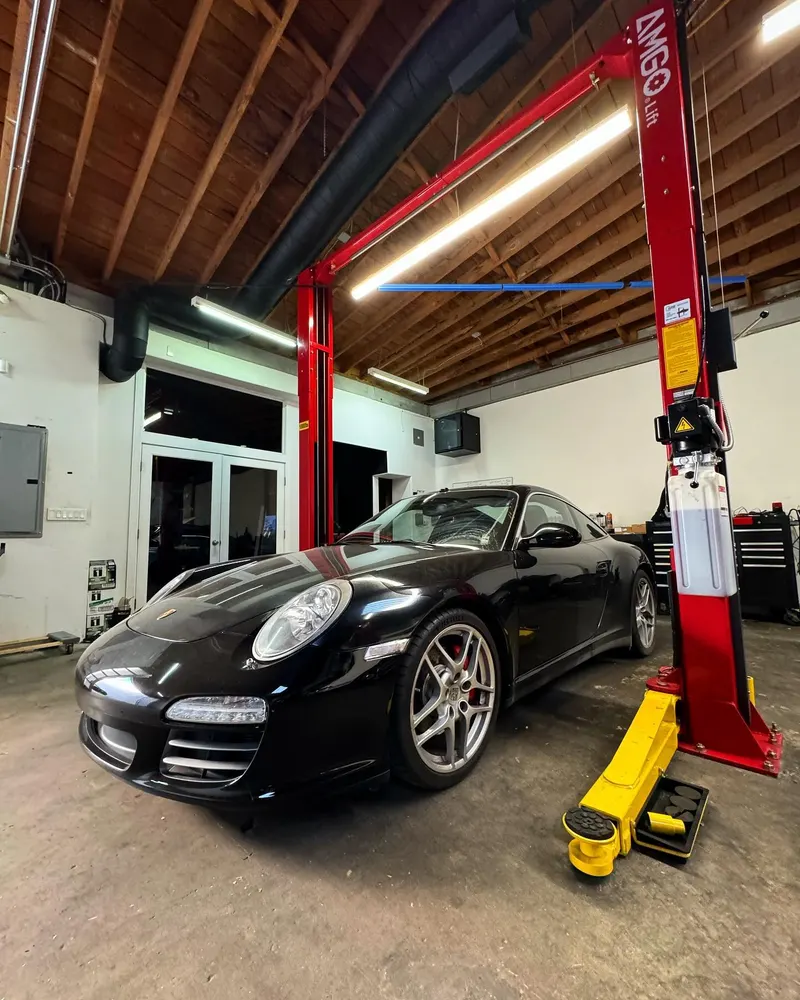
What is Porsche suspension repair?
Porsche suspension repair is replacing the parts that hold each wheel in place and control how it moves: dampers (shock absorbers), springs, control arms and their rubber bushings, drop links, ball joints and wheel bearings. On some Cayenne, Panamera and Macan models it also covers air suspension. Like a lot of Porsche repair, it usually starts with a knock you've been hearing for a while.
These parts wear gradually. The car rarely stops working. It gets noisier, looser and harder on its tires, slowly enough that most owners adapt without noticing. Many Porsches also have PASM, electronically adjustable dampers that change firmness as you drive, and those can fail electrically as well as by wearing out.
Some symptoms cross over into other systems. A shake through the steering wheel under braking can be the brakes or the suspension, so it's worth looking at the suspension and the Porsche brake repair side together.
Why does Porsche suspension repair end with an alignment?
Because every arm and damper helps set the angle of the wheel. Each arm bolts to the car through rubber bushings, and some of those bolts are the adjusters used to set the alignment. Take an arm off, or fit a new strut, and the wheel's angles move. A car sent home without an alignment will drive fine and quietly wear its tires on angles nobody checked.
Tires are where worn suspension turns into real money. A 911 is set up with its rear wheels leaning in slightly at the top, called negative camber, so the inside edge of the rear tires wears first even on a healthy car. Add a worn bushing and that edge can be down to the cords while the outside still looks fine. You can't see it without getting under the car.
Dampers are replaced in pairs across an axle. A new one next to a worn one gives the car two different damping rates side to side, so it behaves differently turning left and right. Doing one axle at a time is normal. Doing one corner is not.
How Los Angeles driving affects your Porsche suspension
The Westside is rough on low, stiff cars. Speed humps and alley dips in Venice and Santa Monica, broken lanes on Sepulveda, and steep driveways in the hills above Sunset all hit the same bushings and drop links again and again. Each sharp hit is small. Over a few years of daily driving, they're what crack rubber bushings and loosen links.
Heat and time add to it. Rubber bushings and air springs harden and crack with age, and a car that bakes in a sunny driveway in the Valley or sits for months in a Bel Air garage ages them whether it's driven or not. On Mulholland and Malibu Canyon, a worn damper shows itself as a car that keeps floating after a dip instead of settling.
Signs you need Porsche suspension repair
A creak or clunk over bumps
Creaks often come from control arm joints, clunks under braking from thrust arm bushings.
A light rattle on rough roads
Usually a worn drop link on the anti-roll bar. A simple fix, best done before it gets louder.
Tires worn on the inside edge
Run your hand across the full width of each tire. A smooth or feathered inner edge is a clue.
The car floats after a dip
A damper that has lost its oil lets the body keep moving after the bump has passed.
A PASM or chassis warning
A stored fault usually names the corner. Note the exact message and whether the ride went firm.
One corner sits low after parking
On air suspension, a spring or line is leaking. Book before the compressor wears out covering for it.
What a Porsche suspension repair usually covers
Suspension work generally means finding the parts that have play, leak or have failed, and replacing those. Depending on the car, it can involve:
- Control arms, bushings and ball joints with play
- Dampers that leak or no longer control the body
- Drop links, top mounts and wheel bearings
- Reading PASM and air suspension fault codes
- Air springs, struts, lines, valves and compressors
- Comparing ride height corner to corner
- A wheel alignment after any part that locates the wheel
Porsche suspension repair on every model
The layout changes a lot across the range:
911
Struts up front and a multi-link rear. Front control arm and thrust arm bushings are the usual wear points.
Boxster and Cayman
Struts at both ends. Front control arms, drop links and top mounts are the common wear items.
Macan
A heavy SUV on multi-link axles, with steel springs or optional air suspension. Lots of bushings, and they wear with the miles.
Cayenne
The heaviest Porsche, on steel springs or air. Air springs crack with age, and a slow leak can wear out the compressor.
Panamera
Many have air suspension, and a nose that sits low after a night parked is the classic sign of a leaking front strut.
Repair the worn part or replace more?
Sometimes one bushing is worn and the rest are fine. On many Porsche arms the bushings and ball joint are sold as part of the arm, so the fix is a new arm rather than a bushing alone. That can look like an upsell, but it's how the parts come, and it often saves labor.
Air suspension is the other big choice. When one air spring leaks, the others are the same age. Replacing only the leaking one is fine if the rest hold pressure. What doesn't work is replacing the compressor without finding the leak, since the new one then fails the same way.
When you don't need suspension repair
A thin, dusty film of oil on a damper is normal, because every damper lets a little oil past its seal. It needs replacing when it's wet and dripping, or when the car shows it on the road. And a dry-weather creak from a bushing with no measurable play is an annoyance, not a safety issue. It can usually wait until the next set of tires.
Why Westside Porsche owners choose The Werkstatt
Porsche is the only make we've worked on, for more than 30 years. We're an independent shop with one location, 10527 Santa Monica Blvd in West Los Angeles, and we work on every model line from the 911 and Boxster to the Cayenne and Panamera.
Here's how it works: you bring the car in, we evaluate the suspension, and we give you a quote.
Book Porsche suspension repair in West Los Angeles
Have the model and year ready, whether the car has PASM or air suspension, and what you hear or feel, at what speed and on what kind of road. For Porsche suspension repair near you in Los Angeles, request a quote and we'll get back to you as soon as possible, or call (310) 310-3959. Bring the car to Santa Monica Boulevard in West LA and we'll evaluate it and give you a quote. If a noise only happens on one street, make a note of which one.