What is Porsche brake repair?
Porsche brake repair is replacing the parts that wear out and fixing the ones that fail: pads, discs (also called rotors), wear sensors, calipers, hoses and the parking brake. Most visits are pads, or pads and discs, on one axle. It's the most routine job in Porsche repair, and it's where knowing what's actually worn saves the most money.
Porsche brakes aren't like an ordinary car's. Most Porsche calipers clamp from both sides with several pistons each, and the color tells you the system. Black or silver is the standard brake, red is the bigger brake on many S and Turbo models, yellow is the carbon-ceramic PCCB, and white is the coated PSCB. Each uses its own pads and discs.
Brake fluid changes are part of routine service: see Porsche brake fluid service. A soft or sinking pedal, though, is a repair, and it starts here.
Why do Porsche brakes need measuring before parts are replaced?
Because the dash warning only tells part of the story. A Porsche wear sensor is a small wire loop clipped into some of the pads, not all of them. When that pad wears down, the disc cuts the wire and the light comes on. It says nothing about the other pads, so a sticking caliper can wear one pad to the metal with no warning at all.
The sensor is also destroyed by doing its job. Once the light is on, the sensor has to be replaced along with the pads, or the warning won't go out. If the pads are changed before the light comes on and the sensors are still in good shape, they can usually go back in. It's a small saving, but it's yours.
Discs are a measurement too. Every disc has a minimum thickness, usually stamped on it. If yours is above that with room to last another set of pads, and it has no deep lip or cracks, it stays on the car. Porsche discs are replaced rather than machined, because machining removes the very thickness that limit protects.
How Los Angeles driving affects your Porsche brakes
Westside traffic is hard on pads and discs. The stop-and-go on the 405 and the 10 means hundreds of short stops on every commute, and pads wear by the stop, not the mile. Coming down Mulholland, Topanga or Malibu Canyon toward PCH, the brakes heat up again and again with little time to cool, which is when pads glaze and drilled discs start to crack.
Near the coast, the marine layer adds rust. A Porsche parked outside in Santa Monica, Venice or Marina del Rey often has a thin orange film on its discs by morning, and the first few stops wipe it off. Cars that sit for weeks in Beverly Hills or Bel Air garages can rust more deeply, which can leave rough patches and a grinding sound that seems worse than it is.
Signs you need Porsche brake repair
The brake wear light is on
A sensor has been cut. There's a little pad left, not a lot. Book within days, not months.
Grinding or scraping
A pad is down to its steel backing and cutting the disc. Stop driving and call us.
A shake when you brake
Usually uneven pad deposits on the discs, sometimes a worn suspension bushing. Note the speed it starts at.
The car pulls to one side
Often a sticking caliper or a collapsed hose. One wheel is usually dirtier and hotter than the other.
A soft or sinking pedal
It could be air, a leak or tired fluid. Don't keep driving on it. Call and describe what you feel.
A parking brake that won't hold
Worn shoes or a cable on older cars, a motor or switch fault on electric parking brakes.
What a Porsche brake repair usually covers
A brake repair generally starts with the wheels off, so the pads and discs can be seen and measured. Depending on what's worn, it can involve:
- Measuring pad thickness at all four wheels, inner and outer
- Measuring disc thickness against the minimum, plus the lip and any cracks
- Replacing wear sensors that are cut or brittle
- Freeing or replacing calipers with sticking pistons, torn dust boots or worn pad guides
- Brake hoses and lines, with the age of the fluid compared against the Porsche maintenance schedule
- Parking brake shoes, cables or electric parking brake parts
- New pads and, where needed, new discs, replaced in axle sets
Porsche brake repair on every model
The job changes from one model to the next:
911
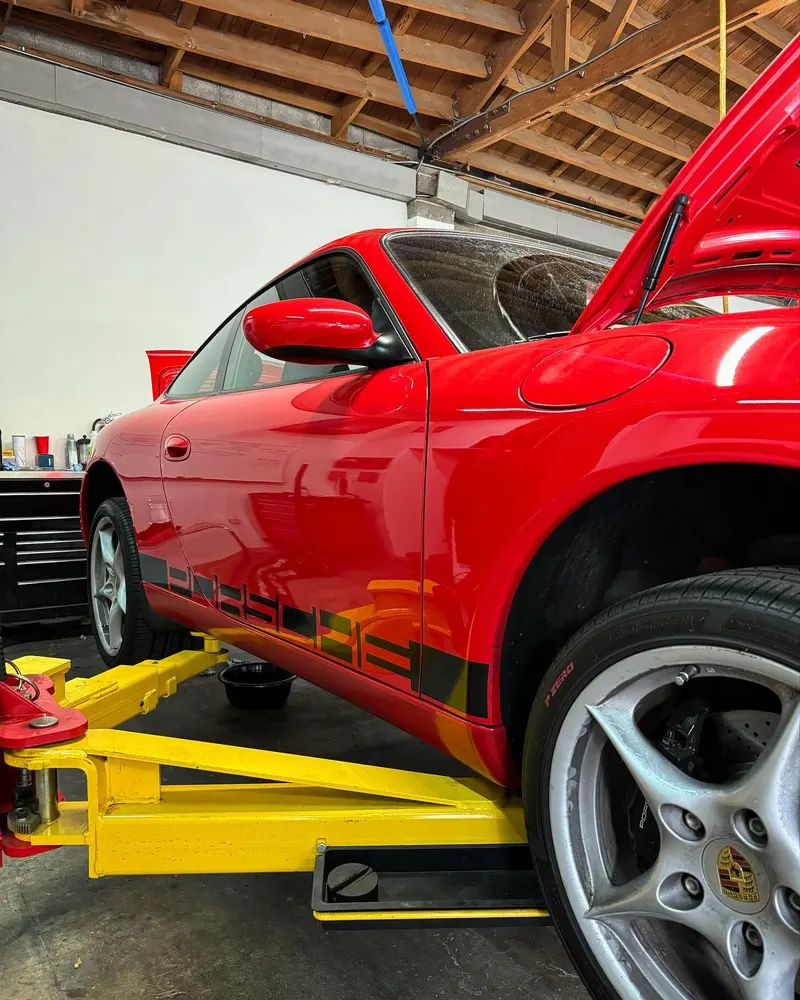
Big multi-piston calipers and, on many cars, cross-drilled discs. Check the caliper color before ordering anything.
Boxster and Cayman
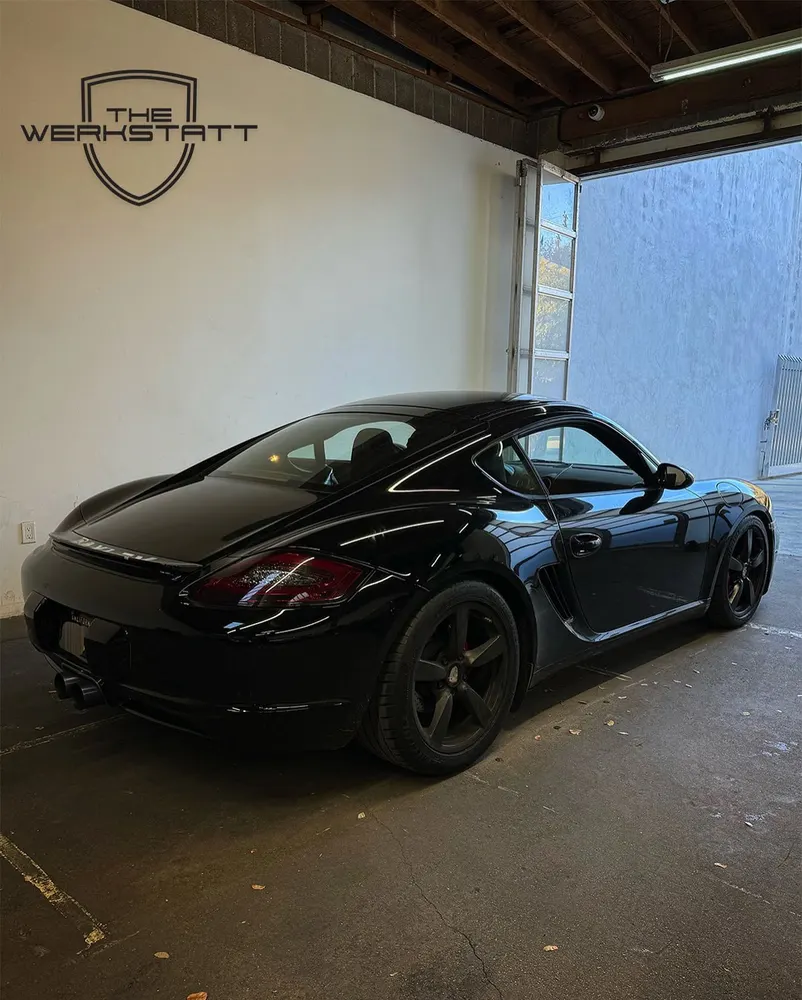
Lighter cars, so pads often last well, but discs on cars that sit in the garage can rust between drives.
Macan
A heavy daily driver with an electric parking brake at the rear, which needs a service mode before the rear pads come out.
Cayenne
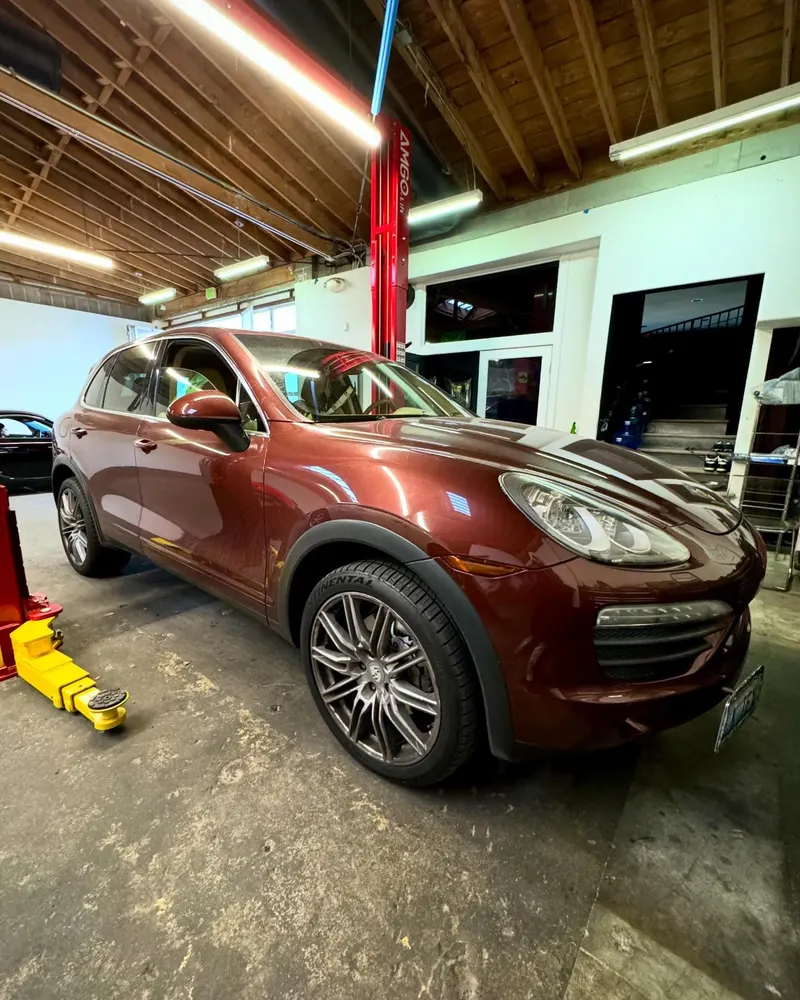
More weight than any other Porsche, so pads and discs usually wear out soonest, and towing speeds that up.
Panamera
Large discs on a heavy car that covers long distances. Both axles often wear at different rates.
Do you need new discs every time you change the pads?
No, and it's the most common upsell in brake work. If the discs measure above their minimum with room to spare, have no deep lip, and show only the fine hairline marks that drilled discs always get around the holes, new pads can go on the old discs. A crack that runs to the edge or links two holes means the disc is done.
Ceramic brakes change the math. PCCB discs can last a very long time on a street car, but they cost many times more than iron discs to replace. The way to protect them is to change the pads early, before they run low and overheat the disc surface. If your ceramic discs are healthy, the right job is pads and nothing else.
When you don't need Porsche brake repair
A light squeal as you roll to a stop, especially after gentle driving, is common on a Porsche. The pads are hard and the calipers are stiff, so they sing a little. If the pads still have plenty of material, noise alone isn't a reason to replace them. And a shake under braking isn't always the brakes. Worn bushings do it too, which is a Porsche suspension repair question.
Why Westside Porsche owners choose The Werkstatt
For more than 30 years, Porsche has been the only make we work on. The Werkstatt is an independent shop at 10527 Santa Monica Blvd in West Los Angeles, and we work on every model line, from the 911 and Boxster to the Cayenne and Panamera.
Bring the car in, we'll evaluate the brakes, and you'll get a quote.
Book Porsche brake repair in West Los Angeles
Have the model and year handy, plus the caliper color, what you hear or feel, and when the pads and discs were last replaced. For Porsche brake repair near you in Los Angeles, call (310) 310-3959 or request a quote and we'll reach out as soon as possible. Bring the car to Santa Monica Boulevard in West LA, and we'll evaluate it and give you a quote. Worth knowing for afterward: for the first couple of hundred miles on new pads, don't hold the brake hard at a light after a fast stop.