
· By The Werkstatt
The Short Answer
A Porsche usually leaks coolant from the parts that age the fastest: the plastic expansion tank, the water pump, the hoses and their joints, and the radiators. On some models the cause is known by name, like the coolant pipes in the V8 of an early Cayenne. If the low coolant warning comes on or the temperature gauge climbs, stop driving and have the car checked before the engine pays for it.
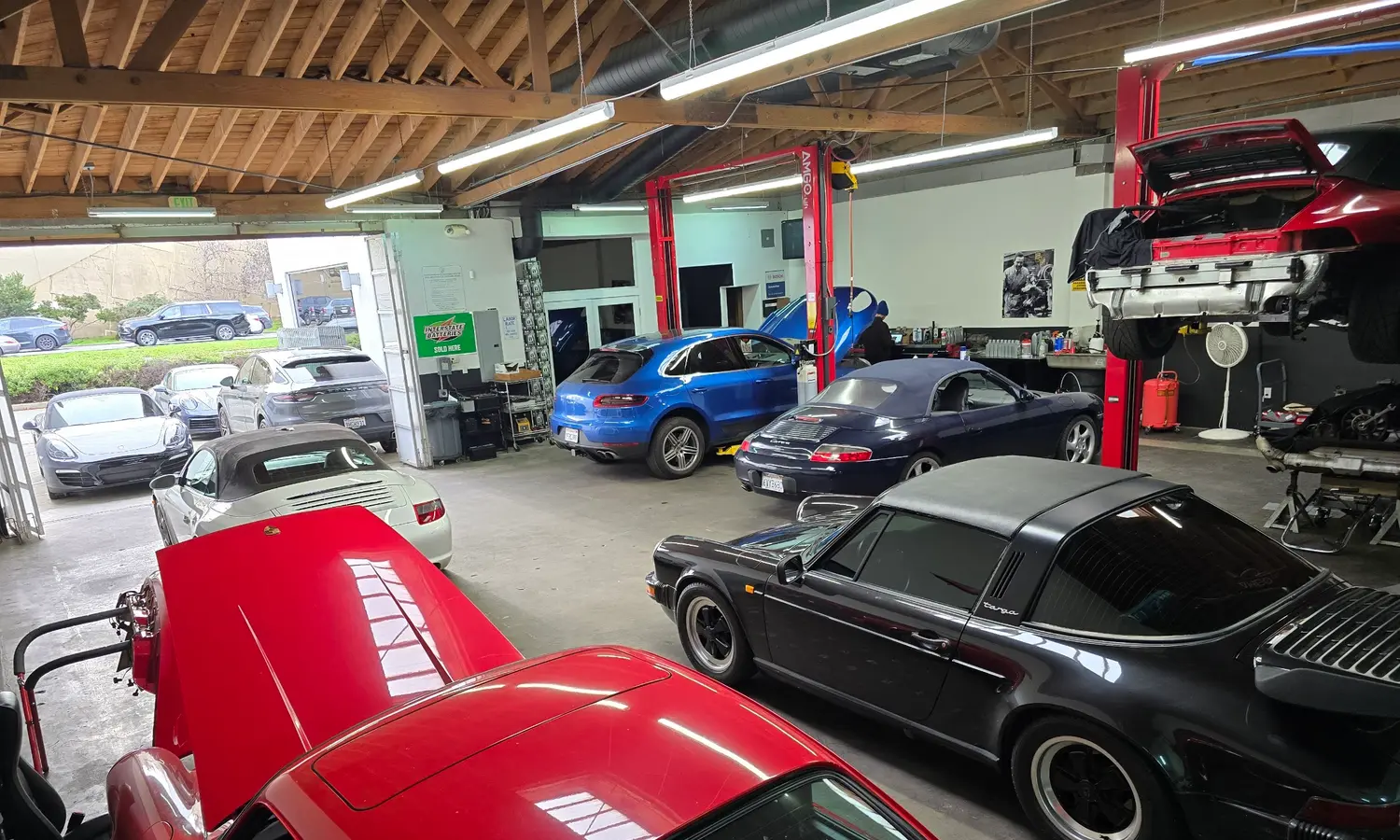
Here at The Werkstatt, an independent Porsche specialist in Los Angeles, we treat coolant leaks on every Porsche model. Below is where leaks tend to start on each model line, how to read the puddle, and what to ask when you bring the car in.
What the Puddle Tells You
Coolant is thin, colored and smells sweet. Rub a drop between your fingers and it feels slick but not greasy. Engine oil is darker, thicker and clings to the skin. If you are not sure which one you are looking at, that is common, and our Porsche oil leak repair work starts with the same question.
Clear water that drips under the front of the car after a drive with the air conditioning on is usually just condensation. It has no smell and dries without a mark. Coolant leaves a crusty, colored residue as it dries, often on the tank, a hose clamp or the floor of the garage.
Where the drip lands helps too. A drip at the front of the car points to the radiators and the lines that feed them. A drip near the engine points to the water pump, the hoses or the pipes in the engine bay. A sweet smell inside the cabin, or a film on the inside of the windshield, can point to the heater core.
Common Causes by Model
911 (996, 997, 991 and 992). The 911 carries its radiators up front, far from the engine, so coolant travels a long way through lines and joints. The front radiators sit low and gather leaves and road grit, which hold moisture against them. The expansion tank in the engine bay and the water pump are other usual suspects. Our Porsche 911 specialist page covers what each generation tends to need.
Boxster and Cayman (986, 987, 981 and 718). These mid-engine cars share much of the 911's layout, with radiators in the nose and a long run of coolant lines back to the engine. Expansion tanks, water pumps and the front radiators are the places to look. The engine sits deep in the car, so finding the exact source takes care.
Cayenne. On early V8 Cayennes, the coolant pipes in the valley of the engine are the well-known weak point. When they fail, coolant pools on top of the engine or runs down the back of it, and the repair means taking apart a good deal of the engine bay. Our Porsche Cayenne specialist page explains what each generation is known for.
Macan. On the four-cylinder and each V6, look at the hoses, the water pump and the expansion tank. A Macan that gets driven every day can lose coolant slowly for a long time before a warning shows, so a quick look under the hood pays off.
Panamera. The engine bay is crowded, so a leak in one spot can drip onto another part and hide where it began. Finding the true source matters more here than on most cars, because a guess can mean replacing the wrong part.
When to Stop Driving
Stop the car and switch it off if the temperature gauge rises past its usual place, if a coolant warning appears on the dash, or if you see steam from the engine area. An engine that runs hot can warp parts and damage seals, and that turns a hose or a tank into a much larger engine repair job.
Never open the cap on a hot cooling system. It is under pressure and can spray scalding coolant. Let the car cool fully before you look.
If you only see a small spot on the garage floor and the gauge stays normal, you can usually drive the car in, but do not wait weeks. Coolant leaks rarely fix themselves, and a slow weep can become a sudden failure on the freeway.
When you bring the car in, ask these questions:
- Where exactly is the coolant coming from, and how was that confirmed?
- Is it one failed part, or are nearby hoses and joints aging the same way?
- Has the engine run hot, and does anything else need checking because of it?
- Is this coolant, or could it be oil or another fluid?
Get Your Porsche Checked at The Werkstatt
We diagnose leaks by model and year, and our Porsche cooling system repair covers coolant leaks, overheating, water pumps, radiators and expansion tanks on every Porsche. Our Porsche-only mechanic has 30+ years on the marque.
Call The Werkstatt at (310) 310-3959 to book a look at your car. We are at 10527 Santa Monica Blvd, Los Angeles, CA 90025, on the Westside, open Monday to Friday from 8:00 AM to 6:00 PM. We serve drivers from Santa Monica, Beverly Hills, Culver City, Brentwood and across Los Angeles.